Completion requirements
The Advanced Networks course follows a progressive learning path that begins with fundamental networking concepts and gradually moves toward advanced protocols, infrastructures, and communication technologies.
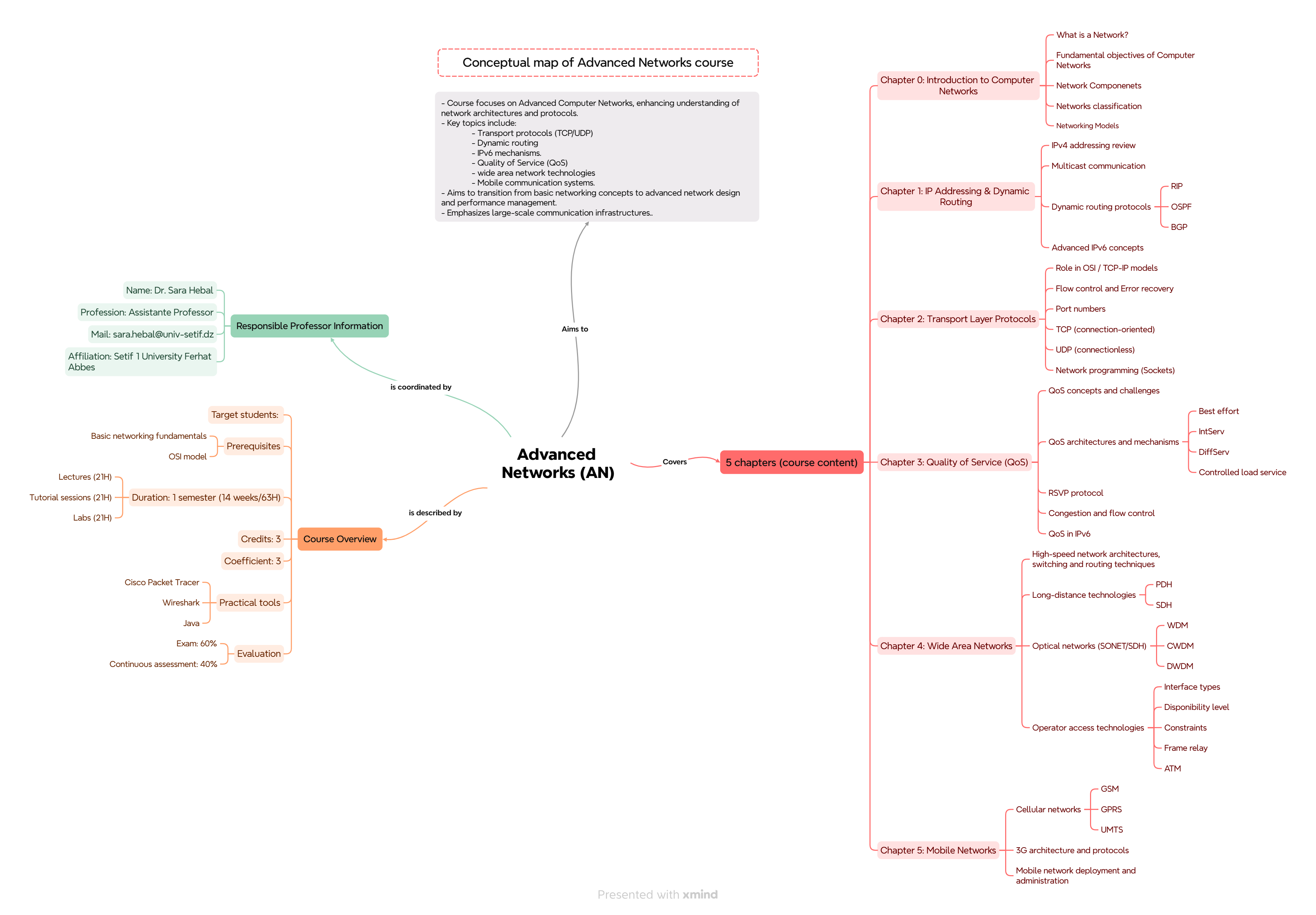
Figure 1. Conceptual map of the Advanced Networks course
The conceptual map provides a visual overview of the course structure and illustrates the relationships between its main topics.
Course Chapters
- Chapter 1 — Introduction to Computer Networks
Students are introduced to the fundamental concepts of computer networks, including network objectives, components, classifications, topologies, communication patterns, and the OSI and TCP/IP reference models.
- Chapter 2 — IP Addressing and Dynamic Routing
This chapter focuses on IPv4 and IPv6 addressing, subnetting, classless addressing, network-layer functions, routing principles, routing algorithms, and dynamic routing protocols such as RIP, OSPF, and BGP.
- Chapter 3 — Transport Protocols
This chapter addresses transport-layer functions and the main transport protocols, with particular attention to TCP and UDP, their characteristics, mechanisms, and applications.
- Chapter 4 — Quality of Service (QoS) in IP Networks
This chapter introduces Quality of Service concepts, performance metrics, traffic management, congestion-related issues, and mechanisms used to improve network performance.
- Chapter 5 — Wide Area Networks (WAN)
This chapter explores WAN architectures and technologies, including digital transmission, optical networks, WDM/DWDM, carrier technologies, MPLS, and GMPLS.
- Chapter 6 — Mobile Networks
This chapter introduces mobile communication networks and their evolution, including GSM, GPRS, UMTS, 3G architectures, communication protocols, and mobile network deployment and management.
Last modified: Wednesday, 2 September 2026, 8:35 PM