Topic outline
-
Welcome to Networks and Web Technologies (NWT)
Building the foundations of modern computer networking and web development.
This course introduces the fundamental concepts that underpin modern computer networks and web applications. Throughout the semester, you will discover how computers communicate, how the Internet operates, and how today's web applications are designed, developed, and secured.
The course combines theoretical concepts with practical examples and laboratory activities. You will progressively acquire the knowledge required to understand network architectures, communication protocols, web technologies, and essential cybersecurity principles.
What You Will Find in This Course
Course Materials
Lecture notes, presentations, and learning resources for each chapter.Laboratory Activities
Hands-on exercises to reinforce theoretical concepts through practice.Assessments
Quizzes and activities designed to evaluate your understanding and progress.Additional Resources
Books, references, and external materials for further exploration.
A Few Tips Before You Begin
- Follow the chapters in the recommended order.
- Complete all quizzes and laboratory activities.
- Review the recommended references whenever necessary.
- Contact the instructor if you need assistance during the course.
-
Course Information
Essential information about the course, its organization, and schedule.
General Information
Faculty Faculty of Sciences University Ferhat Abbas University Sétif 1 Department Computer Science Program Mathematics and Computer Science Applied to Management (MIAGE) Course Title Networks and Web Technologies Course Code NWT Course Unit Fundamental Semester 4 Credits 4 ECTS Equivalent Coefficient 2 Total Workload 42 Hours Target Audience Second-Year Students in Mathematics and Computer Science Applied to Management (MIAGE 2)
Course Schedule
Lecture
Day: Monday
Time: 11:00 – 12:30
Location: Room 10Laboratory Session
Day: Monday
Time: 09:30 – 11:00
Location: Laboratory 5
Course Format
This course combines lectures and laboratory sessions to provide both theoretical knowledge and practical experience. Students are expected to attend all sessions and actively participate in laboratory activities to reinforce the concepts introduced during lectures.
About This Course
Before getting started, take a moment to discover what this course is about and how it will support your learning journey.
-
Who will support you on your learning journey?
Get to know your instructor and learn how to get in touch throughout the course.
 Dr. Malha Merah
Position Associate Professor, Department of Computer Science Institution Faculty of Sciences, Ferhat Abbas Sétif 1 University, Algeria Academic Background Ph.D. in Computer Science with research in dependability in dynamic networks. Email merah.malha@univ-setif.dz Office Hours By appointment via email. Availability Emails are usually answered within 24 hours.
Welcome to the course! I look forward to guiding you throughout this learning journey. Please do not hesitate to contact me if you have any questions regarding the course content, assignments, or assessments. I encourage you to actively participate in the learning activities and make the most of the resources provided.
-
What knowledge and skills will you develop?
The knowledge and skills you will acquire throughout this course.
General Objective
The main objective of this course is to provide students with a comprehensive understanding of the technologies that enable modern computer networks and web systems. By combining theoretical concepts with practical activities, the course prepares students to understand, design, and develop basic networked and web-based applications.
Specific Learning Outcomes
By the end of this course, you will be able to:
01.
Explain the fundamental concepts of computer networks.02.
Identify and analyze the operation of major network protocols.03.
Understand the architecture and operation of modern web technologies.04.
Develop basic web pages using HTML, CSS, and JavaScript.05.
Apply server-side programming concepts and interact with databases.06.
Recognize common security threats affecting computer networks and web applications.07.
Discuss current trends and emerging technologies in networking and web development.-
How is the course organized?
Explore the concept map below to get an overview of the main topics covered in Networks and Web Technologies and how they are connected.
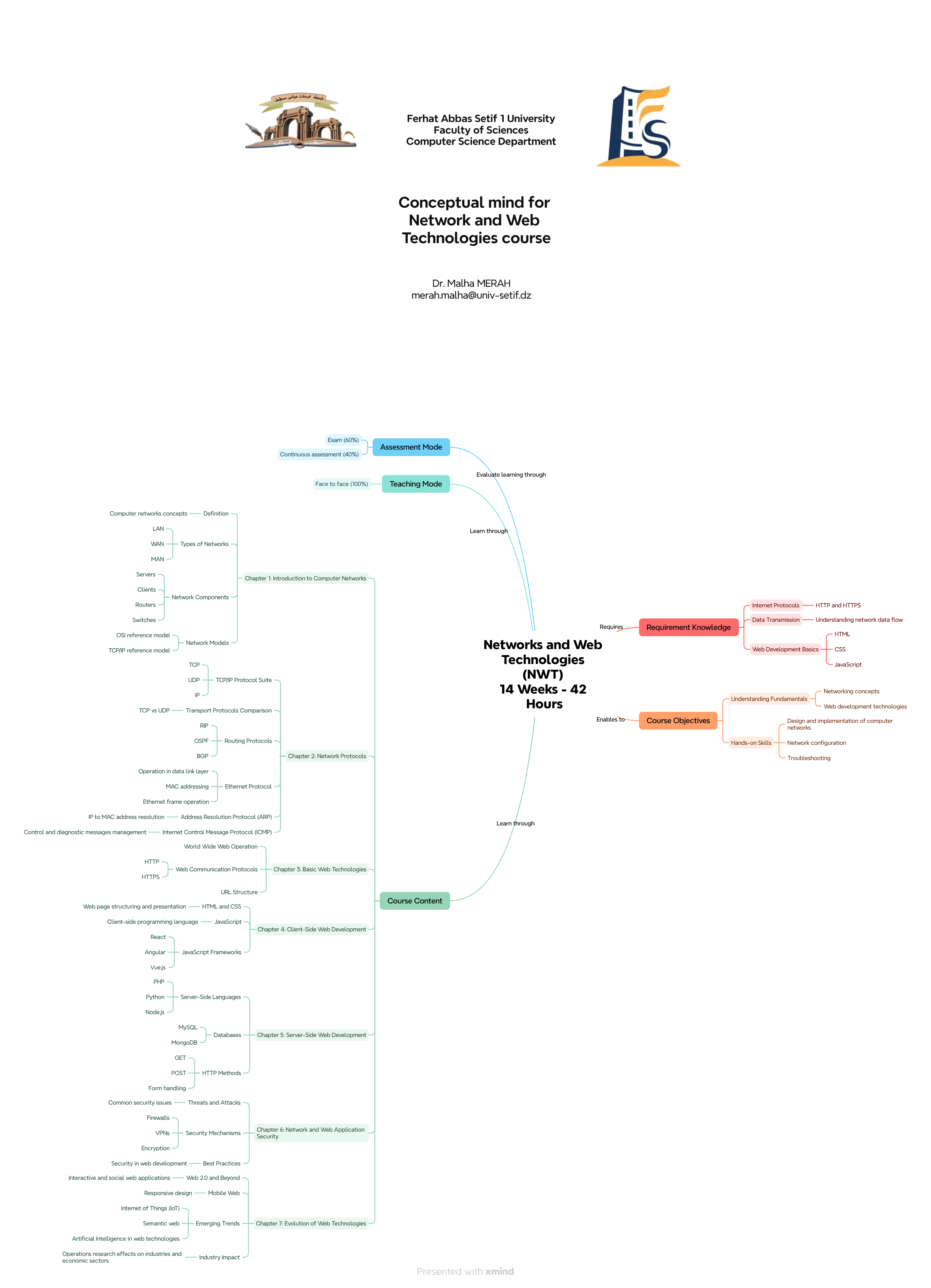
Prefer an offline version?
📥 Download the Concept Map (PDF)
Download the concept map as a PDF.
-
-
What do you need to know before starting this course?
Knowledge recommended before starting this course.
To fully benefit from this course, students are expected to possess a basic understanding of the following concepts. These prerequisites are intended to facilitate learning but are not mandatory.
- A basic understanding of Internet communication protocols, particularly HTTP and HTTPS.
- General knowledge of how information is transmitted through computer networks and the Internet.
- Basic familiarity with web development concepts, including client-side and server-side applications.
- A working knowledge of HTML, CSS, and JavaScript will help you better understand the structure, presentation, and behavior of modern web applications.
Before You Begin
A short self-check will be available before you begin the course. This activity is not graded and is designed to help you assess your prior knowledge of the recommended prerequisite concepts.
If you encounter difficulties with some concepts, you will be directed to recommended learning resources to review them before starting the corresponding course activities. Don't worry if you do not master all the prerequisites yet — the purpose of this self-check is to help you identify what you may need to review.
-
Opened: Friday, 10 July 2026, 7:44 PM
Check your prior knowledge before starting the course.
-
?
Need Help with the Prerequisites?
If you encounter difficulties with the prerequisites, use the external resources below for review.
-
Additional online resources to support your learning and review the prerequisite concepts.
-
What will we explore throughout this course?
A step-by-step learning journey through computer networking and modern web technologies.
This course is organized into seven chapters that progressively introduce the principles of computer networking and web technologies. Each chapter builds upon the previous one, combining theoretical concepts with practical applications.
Chapter 1 — Introduction to Computer Networks
Discover the fundamentals of computer networks, including network types (LAN, MAN, WAN), network components, and the OSI and TCP/IP reference models.
Chapter 2 — Network Protocols
Study the protocols that enable communication across networks, including TCP/IP, Ethernet, MAC addressing, ARP, ICMP, routing, and transport protocols.
Chapter 3 — Basic Web Technologies
Explore the architecture of the World Wide Web, including HTTP, HTTPS, URLs, and the foundations of web communication.
Chapter 4 — Server-Side Web Development
Learn the principles of server-side programming, web servers, databases, and HTTP request processing using GET and POST methods.
Chapter 5 — Client-Side Web Development
Develop interactive web interfaces using HTML, CSS, JavaScript, and discover modern front-end development frameworks.
Chapter 6 — Network and Web Application Security
Understand common cybersecurity threats and learn the essential mechanisms used to protect networks and web applications.
Chapter 7 — Evolution of Web Technologies
Discover how web technologies have evolved, from Web 2.0 to responsive web applications, IoT integration, and artificial intelligence.
-
-
In this chapter, students will discover the fundamental concepts of computer networks and understand how different network components work together to enable communication and data exchange.
The chapter also introduces the main types of networks and the reference models used to understand network communication.
Specific Objective
Describe the basic concepts of computer networks and identify their main components.
Procedural Objectives
At the end of this chapter, students will be able to:
- Define the basic concepts of computer networks.
- Identify and differentiate types of networks (LAN, WAN, MAN).
- Describe the main components of a network (servers, clients, routers, switches).
- Interpret and compare the OSI and TCP/IP reference models.
-
Chapter 1 Video presentation
Content Video
Watch the following video to review the main concepts presented in Chapter 1, including computer networks, network components, network types, and communication models.
Tip: Take notes of the key concepts and important definitions while watching the video.
-
Hands-on Practice: Apply the concepts learned in this chapter through practical activities.
-
Opened: Wednesday, 26 August 2026, 12:00 AMDue: Wednesday, 2 September 2026, 12:00 AM
-
Chat & Discussion Forum: Share your ideas, ask questions, and discuss the topics covered in this chapter.
-
Join the conversation, ask quick questions, and interact with your classmates and instructor in real time.
-
Ask questions, share ideas, discuss course topics, and exchange knowledge with your classmates and instructor.
-
Test Your Acquisition: Check your understanding of the concepts covered in this chapter.
-
-
-
-
In this chapter, students will explore the main network protocols responsible for communication between devices and the exchange of data across networks.
The chapter covers the TCP/IP protocol suite, transport protocols, Ethernet, MAC addressing, ARP, ICMP, and routing protocols such as RIP, OSPF, and BGP, with a focus on understanding their roles and operation in computer networks.
Specific Objective
Analyze the operation of network protocols and routing mechanisms.
Procedural Objectives
At the end of this chapter, students will be able to:
- Explain the operation of the TCP/IP protocol suite.
- Differentiate between TCP and UDP transport protocols.
- Analyze the role of routing protocols (RIP, OSPF, BGP).
- Describe the functioning of the Ethernet protocol at the data link layer.
- Interpret MAC addressing and Ethernet frame structure.
- Explain the role of ARP in address resolution.
- Analyze ICMP messages for network diagnostics and control.
-
Hands-on Practice: Apply the concepts learned in this chapter through practical activities.
-
Opened: Wednesday, 26 August 2026, 12:00 AMDue: Wednesday, 2 September 2026, 12:00 AM
-
Chat & Discussion Forum: Share your ideas, ask questions, and discuss the topics covered in this chapter.
-
Ask questions, share ideas, discuss course topics, and exchange knowledge with your classmates and instructor.
-
Join the conversation, ask quick questions, and interact with your classmates and instructor in real time.
-
Test Your Acquisition: Check your understanding of the concepts covered in this chapter.
-
-
-
How will your learning be assessed?
Assessment combines a final examination, practical work, and a mini-project to evaluate both knowledge and practical skills.
Final Examination
Weight: 60% of the final grade
The final examination assesses students' understanding of the key concepts covered throughout the course, including computer networking, TCP/IP protocols, web technologies, and security.
Practical Work and Mini-Project
Weight: 40% of the final grade
Continuous assessment includes practical laboratory activities and a mini-project designed to help students apply the concepts and technologies learned throughout the course.
-
Opened: Friday, 28 August 2026, 12:00 AMDue: Friday, 4 September 2026, 12:00 AM
-
Which resources were used to develop this course?
Books, articles, standards, and online resources used as references for the course content.
Computer Networking: A Top-Down Approach
James F. Kurose & Keith W. Ross
8th Edition • Pearson • 2021A comprehensive reference covering computer networking principles, Internet architecture, protocols, and modern communication systems.
Networking All-in-One For Dummies
Doug Lowe
Wiley • 2020An accessible introduction to networking concepts, devices, protocols, and network administration.
Modern Networking: An Introduction to Computer Networking
Andrew McDonald
2022A modern overview of networking architectures, communication models, and contemporary networking technologies.
Web Development with Node and Express
Ethan Brown
O'Reilly Media • 2021A practical guide to developing modern web applications using Node.js, Express, and JavaScript.
Learning Web Design
Jennifer Robbins
5th Edition • O'Reilly Media • 2018A comprehensive introduction to HTML, CSS, JavaScript, and responsive web design.
-
Where can you explore further?
Additional online resources to support your learning.
Computer Networking Resources
Explore additional resources to strengthen your understanding of computer networking concepts.
Cisco Networking Academy
A comprehensive learning platform that helps you explore the fundamentals of computer networking, including network devices, protocols, IP addressing, and network communication.
Website: https://www.netacad.com/
Web Technologies Resources
Discover online resources to practice and deepen your knowledge of modern web technologies.
W3Schools
A practical platform for learning HTML, CSS, JavaScript, SQL, and other web development technologies through interactive examples and hands-on exercises.
Website: https://www.w3schools.com/
-
-
Download the course evaluation grid and use it to assess the Moodle course according to the proposed criteria.
-
Opened: Friday, 10 July 2026, 12:00 AMDue: Saturday, 12 September 2026, 11:59 PM
-